Hunt2Prove
On the Hunt for a Better Version of Ourselves, the Forests We Steward, & the Wildlife we Love!
The State of all things Deer: North Carolina Wildlife Resources Commission Deer Management Forums

 Yesterday my daughter graduated from Kindergarten; before I know it, she’ll be graduating from high school and hopefully college. This morning my oldest nephews lay sleeping on the couch beside of me, worn out from yesterday’s pool party and staying up late as ever celebrating their own impending summer vacation; Savanna and Matthew are wide awake doing what 4 and 5 year olds do – Eating breakfast donuts, running through the house, bargaining with me to buy a new iPad game. Deer and deer hunting, and all that it means to me, our state, and our country is the farthest thing from their little minds. For me, it’s always there, at the forefront of my being. It’s also hot on the minds of the North Carolina Wildlife Resource Commission as a new breed of white-tailed deer management begins to take shape across our lands. Tuesday night I had the privilege of being in the room at the 1st of 9 Deer Management Forums happening across the state of North Carolina during the month of June. Like me, those in attendance have deer and deer hunting engrained in their existence. Our one, constructive goal – learn together, grow together, hunt together – as one purposeful body of hunters, all for the betterment our wild deer herd and the future of deer hunting in our state.
Hosted by the North Carolina Wildlife Resources Commission staff, information was presented regarding past and present trends in deer harvests across our state, including last year’s “where did all the deer go” season – where, as statewide harvest data indicated – was down 18% from the previous year. That said, 2013 proved to be an anomaly in itself having been the most successful North Carolina deer season since the beginning of that particular study in 1988. When illustrated in bar graph form, the 2014 season didn’t really stack up all that different from the several years preceding 2013. In the counties where my family and me hunt – Moore, Lee, & Chatham – the overall harvest decline from 2013 to 2014 ranged from 10%-29%. Personally speaking, I didn’t notice any decline in deer activity on the parcels we hunt. One concerned hunter posed the question as to whether coyotes were to blame for this decline, mentioning a video from his property of 16 fawns being dragged into a coyote den over the month of June. Now – I don’t know what everyone else in the room was thinking, but I was certainly wondering how many fawns had to go down a coyote’s gullet before he did something about it? As for me, I’ve never been fortunate enough to find a coyote den and that’s probably a good thing! Otherwise, I could see myself wanting to have a Clint Eastwood and dynamite moment. Yet, regardless of my fantasy on how to kill them, one thing is for certain – It wouldn’t take 16 dying for right before my eyes before I brought the heat and did something about it. More importantly, as pointed out by the biologists and NCWRC staff – coyotes are just one of the many elements that may come into play with respect to deer mortality – disease is another. The most prominent disease in NC and for white-tailed deer in general, being EHD – Epizootic Hemorrhagic Disease and happening sporadically across our state, with a significant occurrence in the eastern most counties of North Central, NC in 2014. Furthermore, with hunters bringing untested deer carcasses back into our state from other states, and with cervid farming likely expanding across NC over the coming months and years, we now have to worry more than ever and plan in the same sentence for CWD – Chronic Wasting Disease. Whatever the limiting factors that affect our deer populations – coyotes, disease, & the like – it’s up to us as hunters to have the involved presence that is necessary when managing deer populations on the lands we maintain – The NCWRC can’t do it for us. What they can do, however, is present us with the information they collect and work with us to decide how best to move forward with respect to deer management in North Carolina.
 One of the really progressive management points of the night shows a trend in North Carolina away from the harvest of 1.5 year old or yearling bucks over the past 30 years. Although buck age structure from 2011-2014 reported harvests indicates that 40% (the majority) of all bucks harvested over the course of the study period where 1.5 year old deer, that’s down 20% from a 1983-1985 study. And, when the buck harvest rates of one specific age group go down, that normally means others are going up; most specifically in North Carolina, our 2.5 & 3.5 year old harvests steal the hunt, literally. At the beginning of the forum, 83% of attendees (myself included) felt we still shot too many yearling bucks, and we do – at least in my eyes. After visualizing the trend presented, though, the positive direction that we’re heading was unmistakable, which also brings up another question. Are we willing to sacrifice seeing more deer to see better, healthier deer? – Healthier deer being a by-product of reducing population size while improving the diversity of the lands we steward (diversity relating to food, water, cover, and hunt-able edge). Again, the majority of the 60 plus hunter driven crowd, said yes – North Carolina deer hunters are willing to see less deer for the chance at harvesting a better one. Yet as the many questions and concerns raised by members of the crowd who have been seeing less deer of late would point out, it’s still tough for some to comprehend or become accustomed to the correlation between fewer deer and quality deer. Perhaps we need more deer management forums like this one to further educate the North Carolina deer hunter? 98% of those in attendance said “yes we do” and I’m compelled to agree. Educating yourself, however you do it, is the precursor to success. These forums will do well to educate North Carolina deer hunters who can then share the newly found information with others.
 All of the information presented at the forums will soon be available online at: www.ncwildlife.org. To each of the North Carolina Wildlife Resource Commission staff that made these forums possible – I applaud and appreciate you. Some questions have been answered; still others lie just upon the horizon. Will season’s change in the future to ensure more bucks are still alive and on the hoof during the peak of the rut, which ranges from October 2nd to December 6th depending on where in the state you hunt? – A question that stems from the fact that 50% of our total buck harvests in North Carolina occur before peak breeding. Anything is possible – at least when the North Carolina deer hunter works hand in hand with the North Carolina deer biologists and other fellow hunters to make certain that the issues affecting whitetails in our state remain a priority. To prevent a statewide mutiny, the NCWRC seeks to work hand in hand with hunters before making any decisions on the future of the white-tailed deer that roam our lands. The way I see it, if you don’t take the initiative to cast a vote, don’t take the initiative to complain when others make decisions for you. Much is the same with being a constructive hunter who has an involved presence with respect to the game we hunt – whether you can attend one of the remaining forums or not, seek to further your knowledge of the white-tailed deer, share it with others, and present your own ideas.
To get in touch with your local NCWRC Biologist use the following link:
http://www.ncwildlife.org/Portals/0/Hunting/Documents/WMDistrictBiologistContacts.pdf
Minerals – Take One


Using minerals for deer isn’t something new. But, the way I see it – It may be new to someone who reads this: Share your Outdoor Story! – You never know when you’re gonna run across the one person that just might need to hear it!
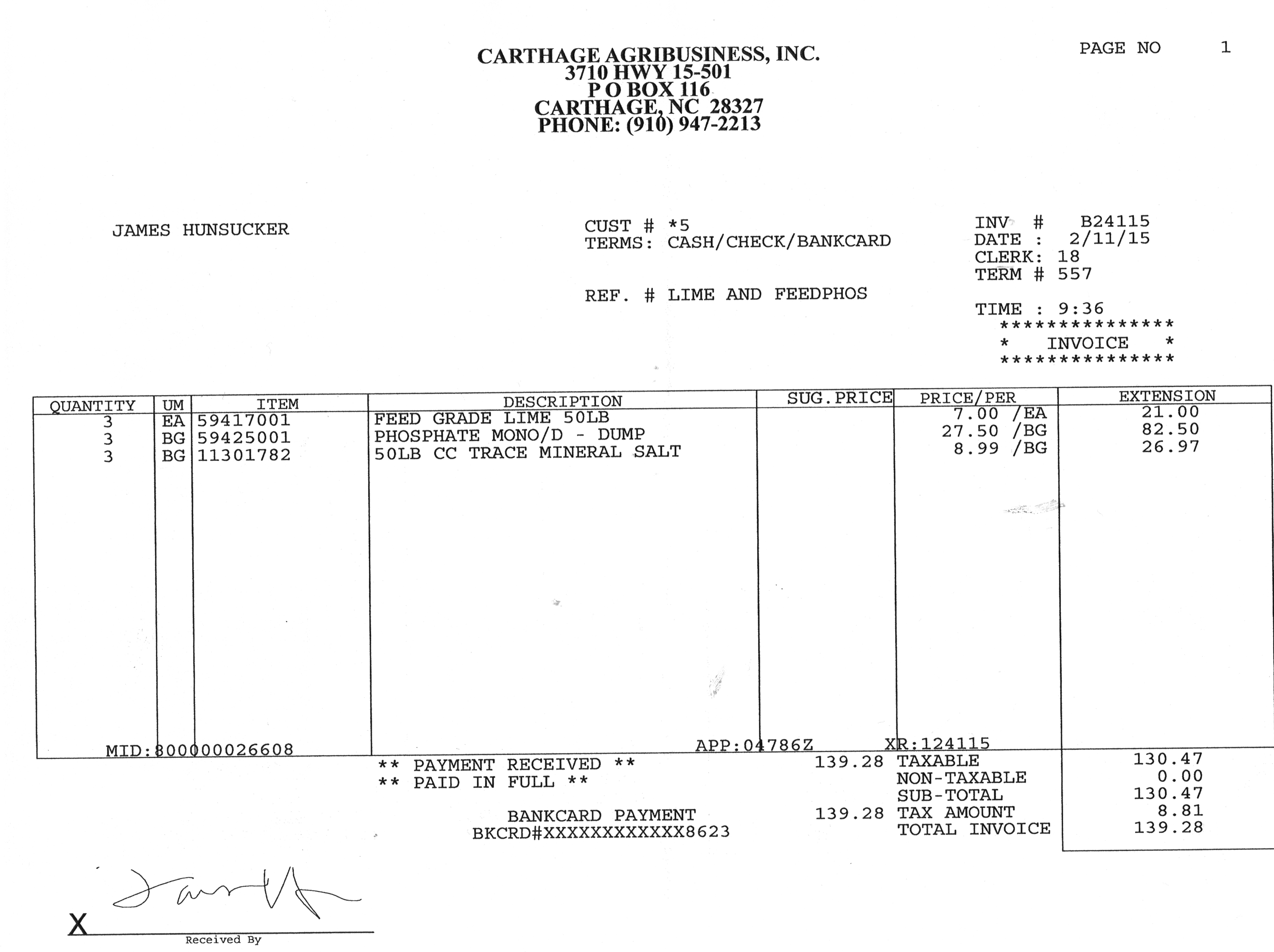
On March 7th, 2015 my nephews and I created a new mineral lick on a property we’re privileged to hunt. For approximately $46.00 per site, using a homemade recipe discussed in the Quality Deer Management Association’s – Deer Steward I online course, we made out like bandits in terms of improving the health of the deer herd on the lands we maintain.
It all starts with:
50# Granular Calcium Carbonate (Feed Grade Lime)
50# DiCalcium Phosphate
50# Trace Mineral Salt
Forming a hodgepodge of the above ingredients we then distributed approximately 150 pounds of the mixture at each of the three new sites we selected. The selection process hinged on finding an area with predominantly clay soils due to their ability to hold water and nutrients with minimal leaching – putting granulated or pulverized minerals in sandy soils would be counterproductive, as the majority of the nutrients would percolate to underlying layers of the soil profile making access by deer and other wildlife improbable.
In less than three months this site has gone from seeing little-to-no activity to around-the-clock visits. Moving forward it will serve as a sanctuary where deer can come to stock up the minerals they need without fear of being stuck with an arrow, positively impacting the health of the herd whenever they need it most!

For more information on minerals and their benefits for deer, check out Minerals for Whitetails – an online article posted by the Quality Deer Management Association.
Photos from the Wilder side of Life!


